Gemology For Beginners: Everything You Need to Know About Gemstones

Are you curious about where gemstones come from, what factors decide their value, or who determines their worth? There is a world of science, nature, and craftsmanship behind every eye-catching gemstone.
Its colour, brilliance, inclusions, and physical structure can reveal valuable information about how it formed and what makes it unique. Whether you are a jewellery enthusiast or thinking about buying a gemstone, understanding the basics of gemology will help you to appreciate gemstones with greater knowledge and insights.
Let's explore the gemstone guide for beginners below in the blog.
What is Gemology
Gemology is the scientific study of gemstones, including their physical, chemical, and optical properties, as well as their treatments.
It involves knowledge from fields such as mineralogy, geology, and chemistry to understand what makes each gemstone different from another.
A professional gemologist assesses the gemstone s identity and characteristics using intense observations, microscopes, and refractometer tools.
This knowledge is essential for examining gemstones accurately and maintaining transparency among jewellers, suppliers, and buyers.
In simple terms, gemology connects science with the beauty of gemstones.
Understanding Different Types of Gemstones
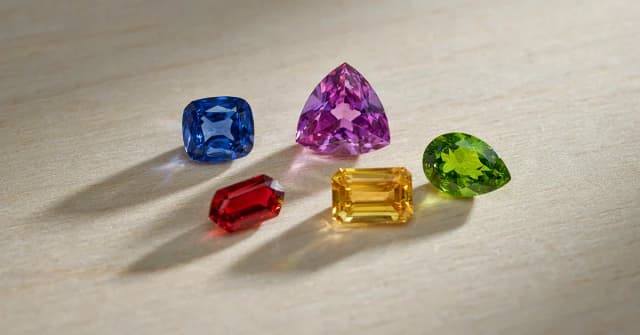
Gemstones are minerals, rocks, or organic materials formed beneath the earth or in a laboratory that are valued for their beauty, durability and rarity and are commonly cut, polished and used in jewellery or decorative objects.
Gemstones are traditionally classified as precious, semi-precious, and organic based on a a range of colours, compositions, and origins.
Precious Gemstones
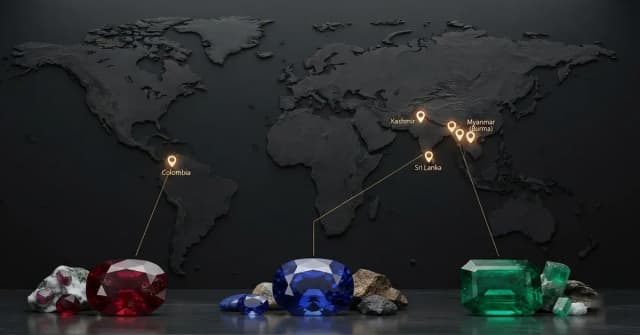
The traditional precious gemstone group includes diamonds, ruby, sapphire, and emeralds. These stones have long been characterized by rarity, durability, and fine jewellery.
Diamonds are known for their exceptional hardness and brilliance, while rubies and sapphires are varieties of corundum, and emerald belongs to the beryl family.
Semi-Precious Gemstones
The semi-precious category includes a variety of stones, such as amethyst, aquamarine, garnet, tourmaline, topaz and peridot.
Each of the semi-precious gemstones has its own colour range, physical properties and characteristics.
Organic Gemstones
Not all gemstones are made up of minerals, for example pearls, amber and coral, for have organic origins.
Pearls develop within molluscs, amber comes from fossilised tree resin, while coral is formed by marine organisms. This difference makes mineral gemstone different from organic gemstones
Key Properties Determine Gemstone Value
Colour: Colour is the first thing that one notices about a gemstone, which determines its beauty and value. Colour is usually described as hue, tone, and saturation.
Clarity: It refers to the internal inclusions and surface blemishes in a gemstone. Natural inclusions can help gemologists to distinguish natural gems from synthetic or treated ones.
Hardness: Hardness indicates a gemstone s resistance to scratching. It is measured using the Mohs scale, where diamond ranks 10, while talc ranks 1.
Luster: Luster describes how light reflects from a gemstone s surface. Depending on the material, luster may appear vitreous (glassy), silky, pearly, metallic or resinous
Transparency (Diaphaneity): It refers to how easily light passes through a gemstone. Stones can be classified as transparent, translucent or opaque, depending on how much light they transmit
Refractive Index (RI):RI is an important tool for gemstone identification. It measures how much light bends when it enters a gemstone. As different gemstones have characteristic RI ranges.
Specific Gravity (SG): SG refers to a gemstone density relative to water. Gemologists use SG, along with other tests, to help distinguish between different gem materials.
Optical Properties: Optical features such as double refraction (birefringence), pleochroism and fluorescence can provide useful clues about a gemstone s identity and how it behaves under different lighting conditions.
Durability: A gemstone s suitability for jewellery depends on more than hardness. Durability is determined by hardness (resistance to scratching), toughness (resistance to breaking or chipping), and stability (resistance to heat, light, chemicals and humidity)
Must Read: Certificate Decoded: Reading GIA Coloured Stone Report
Difference btw Natural, Synthetic and Imitation Gemstones
|
Key Difference |
Natural |
Synthetic |
Imitation |
|
Composition |
Naturally occurring minerals/organic material |
Same composition as natural counterpart |
Different material |
|
Formation |
Formed naturally over millions of years |
Lab-created under controlled conditions |
Manufactured to mimic another gem |
|
Optical Properties |
Refractive index and dispersion depend on the gemstone's composition and structure. Cut, clarity, and polish affect brilliance. |
Similar optical properties to natural counterpart |
Different optical properties |
|
Physical Properties |
Hardness depends on the gemstone species. Natural inclusions are commonly present. |
Generally similar to natural counterpart |
Depends on material used, like plastic, glass or ceramic |
|
Value |
Usually highest due to rarity |
Generally more affordable |
Usually lowest |
|
Environmental Impact |
Mining can disturb land and ecosystems |
No conventional mining; still uses energy/resources |
Depends on materials and manufacturing |
Certification, Professional Examination and Gemstone Treatments
To assess a gemstone s identity and characteristics, a certificate from a recognized institute helps to build trust in the gemstone.
GIA, Gemological Institute of India (GII), Gübelin Gem Lab, SSEF, AGL, AIGS and Lotus Gemology are the renowned institute offer testing or certification services.
Professional gemology also covers understanding gemstone treatments, which are processes used to improve a stone s colour, clarity or appearance.
Common treatments include heat treatment, fracture filling, irradiation, dyeing and surface coating.
Understanding these treatments is important because they can affect a gemstone s care requirements, durability and value.
Must Read: How to Import & Export Gemstones in India: 2026 Updates
Tools and Techniques Used by Gemologists
Gemologists use a combination of observation, instruments and testing methods to examine the characteristics of gemstones. No single test is sufficient for every gemstone, so results are depend on combination of methods.
|
Tool / Technique |
What It Tests |
|
10× Loupe |
Inclusions, surface features, polish quality and visible treatment clues |
|
Gemological Microscope |
Inclusions, growth patterns, fractures and treatment indicators |
|
Refractometer |
Refractive index (RI) and, in suitable stones, birefringence and optic sign |
|
Polariscope |
Optical character (singly vs doubly refractive) and strain patterns, help to determine whether gemstone is isotropic or anisotropic. |
|
Dichroscope |
Pleochroism (different colours/shades from different directions) |
|
Spectroscope |
Light absorption patterns (absorption lines and bands),help separate natural from synthetic stones. |
|
UV Lamp |
Fluorescence under ultraviolet light (long-wave and/or short-wave) |
|
Specific Gravity Testing |
Density relative to water (specific gravity, SG) |
How to Learn Gemology as a Beginner
- Set Your Goal: Decide whether you want to learn gemology as a hobby, for jewellery work, or as a professional career.
- Learn Basics: Start with a basic understanding of physical and optical properties, inclusions, treatments and essential gemological terminology.
- Use Resources: Learn through reliable books, online courses, educational videos and authentic study material from established gemological organisations.
- Study Systematically: Focus on one gemstone family at a time. Learn its typical colours, inclusions, properties and common treatments before moving to another group.
- Find Mentors: Join gem and mineral communities or seek guidance from experienced gemologists and jewellers.
- Pursue Certification: If you want to work professionally, consider a recognised gemology programme or qualification that combines theoretical learning with practical training.
How to Identify Gemstones as a Beginner
1. Start with a Visual Examination
Examine the gemstone under natural light near a window or led light. Look closely at its colour, transparency, lustre, cut, and surface, as these features can provide the first clues about its identity.
Natural stones often show subtle variations in tone and saturation; very flat, overly perfect colour can indicate glass, plastic, or some synthetics.
2. Examine the Gemstone with a 10× Loupe
A 10× loupe allows beginners to see inclusions, fractures, scratches and other details that are difficult to notice with the naked eye. Natural gemstones often contain characteristic internal features.
While features such as perfectly round gas bubbles may suggest glass. Scratches, nicks, and uneven polish can indicate softer materials or poor-quality imitations
3. Check Hardness and Density Carefully
Hardness, measured on the Mohs scale, indicates how resistant a gemstone is to scratching, while density helps distinguish materials of similar appearance.
Hardness testing should be approached cautiously because scratching can damage a polished gemstone or jewellery.
Practical Tip: If a “gemstone” scratches easily with a steel file or key, it s unlikely to be a hard gem like sapphire, ruby, or topaz
4. Use a UV light to check
A small UV torch reveals useful patterns, such as some natural gems like rubies and diamonds are fluoresce in characteristic colours under UV.
Unusual or overly strong fluorescence can sometimes indicate treatments or synthetic materials.
Always view fluorescence in a dark environment and compare with known examples when possible.
5. Look for red flags of common imitations
Certain features strongly suggest a stone is not what it claims to be; for example, air bubbles, swirls, or flow lines are likely to be glass.
Mold marks, seam lines, or overly uniform colour may be glass, plastic, or low-quality synthetic.
Too-perfect clarity at a very low price could be lab-created or an imitation.
Beginner's Checklist for Buying Gemstones
- Know the gemstone variety
- Ask whether it is natural, synthetic or a simulant
- Check for treatments
- Understand its quality characteristics
- Ask about origin where relevant
- Request a reputable laboratory report for significant purchases
- Compare price with quality and rarity
Conclusion
Gemstones are far more than beautiful stones that add colour and sparkle to jewellery.
Learning the basics of gemology helps you understand where they come from, what makes them different, how their quality is assessed and why their value can vary so widely.
From recognizing natural, synthetic and imitation gemstones to understanding their properties, treatments and identification methods, every detail adds to the bigger picture.
For beginners, the best approach is to learn gradually, observe real gemstones and rely on trusted gemological sources when making important decisions.
With curiosity and practice, gemology can turn a simple interest in gemstones into deeper knowledge and appreciation.
Stay updated with GemstoneToday for more gemstone related information.

Pankhur Grover
Pankhur is a Content enthusiast who loves to bring stories to life through words. She enjoys turning complex ideas into engaging, informative content. Her curiosity often leads her to discover inspiration from the most unexpected places. From the world of fashion and lifestyle to gemstones and jewellery, she loves discovering fresh perspectives and bringing interesting details to readers.
- What is Gemology
- Understanding Different Types of Gemstones
- Key Properties Determine Gemstone Value
- Difference btw Natural, Synthetic and Imitation Gemstones
- Certification, Professional Examination and Gemstone Treatments
- Tools and Techniques Used by Gemologists
- How to Learn Gemology as a Beginner
- How to Identify Gemstones as a Beginner
- Beginner's Checklist for Buying Gemstones
- Conclusion