Certificate Decoded: Reading GIA Coloured Stone Report
A gemstone's true value isn't determined by its beauty alone,it's revealed by its certificate.
Whether you're purchasing a ruby, sapphire, emerald, or another precious gemstone, understanding a GIA Coloured Stone Report is essential for making a confident purchase.
Yet, for many buyers, technical terms and scientific descriptions can be confusing.
In this guide, we'll explain every section of a GIA gemstone certificate in simple terms, so you can confidently understand coloured gemstone certification before making your next purchase.
How to Read a GIA Coloured Stone Report: Step-by-Step Guide
A GIA Coloured Stone Report contains several sections, each providing valuable information about a gemstone's identity, quality, treatments, and origin. Here's a step-by-step guide to reading every section of a GIA gemstone certificate to verify stone credibility.
Report Number
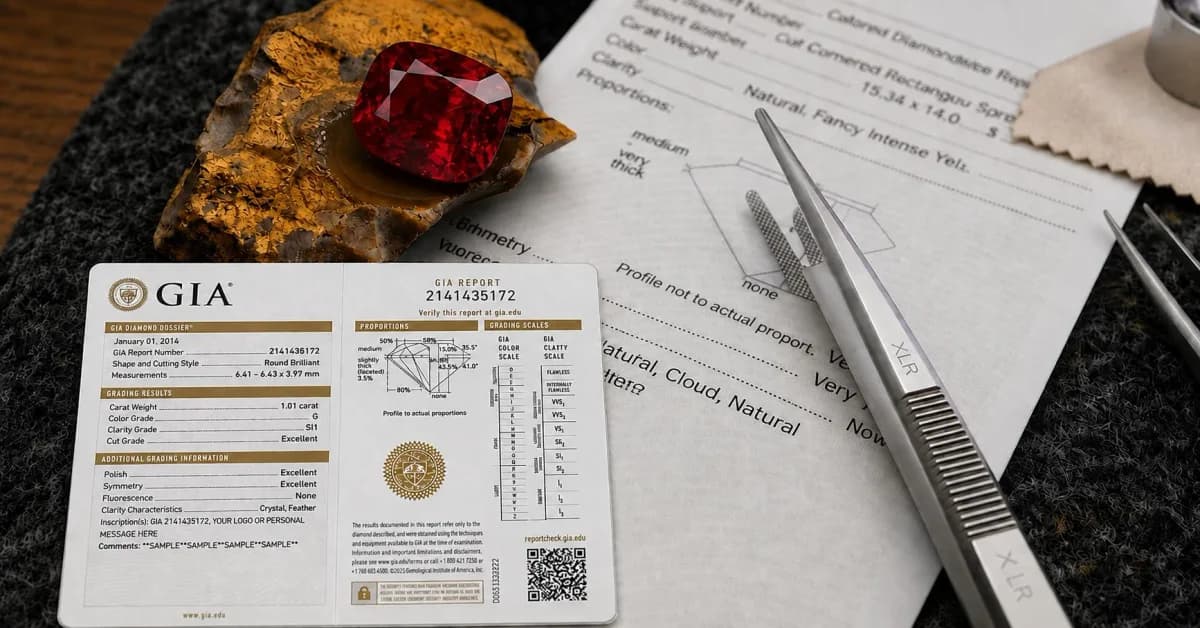
The Report Number is a unique 10-digit identifier assigned by GIA to every coloured gemstone report, linking the gemstone to its official laboratory record.
Found at the top of the certificate and sometimes laser-inscribed on the gemstone's girdle. It can be verified through GIA's Online Report Check portal by entering the report number, which confirms the certificate's originality and ensures that key details of gemstone match the GIA Database.
Date Issued
The Date Issued indicates when GIA examined and documented the gemstone. Although it does not affect the stone's identity or quality, it provides important context about when the report was prepared.
More recent reports reflect GIA's latest testing techniques, terminology, and disclosure standards, making them especially valuable for high value coloured gemstones.
Species And Variety
Species and Variety identify exactly what your gemstone is. The species refers to the gem's mineral family, such as Natural Corundum, Natural Beryl, or Natural Chrysoberyl, while the report also states whether the stone is natural or laboratory grown.
The variety then specifies the gemstone trade name within that species-for example, Ruby or Sapphire for corundum, Emerald or Aquamarine for beryl, and Alexandrite for chrysoberyl.
Colour Description
The Colour section of a GIA Coloured Stone Report describes a gemstone using three key components: hue, tone, and saturation. Hue refers to the gem's primary colour, such as red, blue, or green. GIA uses upto 31 standard hues.
Tone measures how light or dark the colour appears on a scale from 0 (colourless) to 10 (black), with most fine coloured gemstones falling between 5 and 7.
Saturation indicates the intensity and purity of the colour, ranging from grayish or brownish to strong and vivid, the highest level of colour intensity.
Transparency
The Transparency section indicates how much light passes through a gemstone and how clearly it can be seen through.
GIA classifies transparency into three categories: Transparent, where light passes through with minimal scattering and objects are clearly visible.
Translucent, where light passes through but is diffused, making details difficult to see; and Opaque, where light does not pass through the gemstone at all.
Shape and Cutting Style
The Shape and Cutting Style section describes both the gemstone outline and the arrangement of its facets.
The shape refers to the stone view form above, such as oval, cushion, emerald, round, pear, or marquise, while the cutting style explains how the facets are arranged.
Measurements and Carat Weight
The Measurements and Carat Weight section explains both the gemstone's physical dimensions and its weight. Measurements are recorded as Length × Width × Depth in millimetres, while weight is expressed in carats (1 carat = 0.2 grams).
These two details should always be read together, as gemstones with the same carat weight can appear different in size depending on how they are cut.
Understanding both helps you assess the stone's proportions, face-up appearance, and suitability for a jewellery setting.
Geographic Origin
When sufficient evidence is available, GIA may include a Geographic Origin opinion indicating where the gemstone most likely formed.
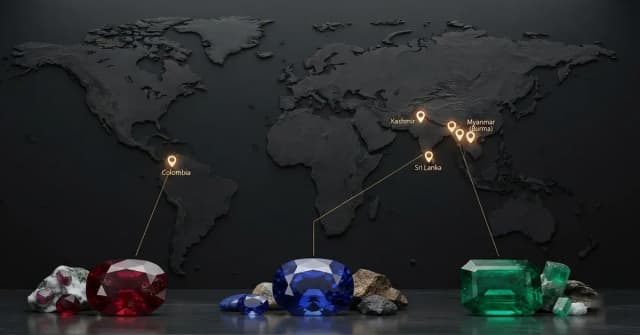
Common origins listed on reports include Myanmar (Burma), Kashmir, Sri Lanka (Ceylon), and Madagascar.
This determination is based on internal characteristics, trace-element chemistry, and other geological features but does not provide absolute certainty.
Comments Section
The Comments section contains additional observations that do not fit within the standard report fields.
It may include further details about gemstone treatments, the extent of clarity enhancement, characteristic inclusions associated with a particular origin, or other notable features such as flux residue.
Treatment Disclosure
The Treatment Information section is one of the most important parts of a GIA Coloured Stone Report, as it discloses any detectable enhancements that can influence a gemstone's value, durability, and care requirements.
Common entries include "Indications of Heating" or "No Indications of Heating" for rubies and sapphires, with unheated stones generally commanding a higher premium due to their rarity.
GIA also reports treatments such as diffusion, fracture filling, and clarity enhancement, while emeralds are often described with the degree of oil or filler present, ranging from Minor to Significant.
Carefully reviewing this section helps buyers understand the gemstone's true condition and make a well-informed purchasing decision.
Key Takeaways
- Higher Value: Gemstones from historically renowned sources often command higher prices due to their rarity, exceptional quality, and strong collector appeal.
- Comparison Method: GIA evaluates gemstone colour objectively using master stones under controlled lighting conditions.
- Accepted Treatments: Minor to moderate enhancements are generally accepted in the gemstone industry, while extensive treatments can significantly reduce a gemstone's value and durability.
- Transparency: The level of transparency influences a gemstone's optical appearance and is an important factor in determining its overall beauty and visual appeal.
- GIA’S three cutting styles: Brilliant cut, which uses triangular and kite-shaped facets to maximize sparkle; step cut, featuring long, parallel facets that emphasize colour and clarity; and mixed cut, which combines elements of both brilliant and step cuts.
Red Flags to Watch for on a GIA Gemstone Certificate
Major Treatment Disclosures
Treatments such as diffusion, fracture filling, glass filling, or significant clarity enhancement can reduce a gemstone's value and affect its durability. Always review the Treatment Information section carefully.
Laboratory-Grown or Synthetic Identification
If the report states "Laboratory-grown" or "Synthetic" instead of "Natural," the gemstone was created in a lab and is generally worth much less than its natural counterpart.
Certificate and Gemstone Don't Match
Ensure the report number, carat weight, measurements, shape, and colour description match the gemstone exactly. Any discrepancy could indicate the certificate does not belong to the stone.
Incomplete or Confusing Comments
The Comments section may contain important information about treatments, inclusions, or clarity enhancements. Although often overlooked, this section can contain important information that affects a gemstone's durability, care requirements, and overall value.
GIA vs. AGL vs. Gübelin vs. SSEF: Gemstone Report Comparison
|
Laboratory |
Best For |
Origin Reliability |
Treatment Details |
Cost to Consumer |
|
GIA |
General gemstone certification |
High |
Comprehensive disclosure |
Moderate-High |
|
SSEF |
High-value & auction-quality gemstones |
Very High |
Highly detailed |
High |
|
Gübelin Gem Lab |
Rare & investment-grade gemstones |
Very High |
Highly detailed |
High-Premium |
|
IGI |
Commercial jewellery & retail certification |
Moderate-High |
Good |
Low-Moderate |
FAQs
1. Does a GIA Coloured Stone Report Guarantee a Gemstone's Value?
2. Can a GIA Gemstone Certificate Be Used For Insurance Or Resale?
Yes. A GIA gemstone certificate provides independent documentation of a gemstone's characteristics, making it valuable for insurance records and resale.
3. Is a GIA Coloured Stone Report Same As a Diamond Grading Report?
No. Unlike a GIA diamond grading report,graded on 4C system, a GIA Coloured Stone Report focuses on identifying the gemstone, disclosing any detectable treatments, and determining its geographic origin.
To Sum Up
A GIA Coloured Stone Report is more than a certificate—it is a trusted document that helps you verify a gemstone's identity, treatments, and overall authenticity.
Knowing how to read a GIA report allows you to make informed decisions, compare gemstones with confidence, and avoid costly mistakes.
Whether you're purchasing a ruby, sapphire, emerald, or another precious gem, understanding each section of the report ensures you know exactly what you're investing in.
Stay updated with Gemstone Today for more gemstone-related information.

Pankhur Grover
Pankhur is a Content enthusiast who loves to bring stories to life through words. She enjoys turning complex ideas into engaging, informative content. Her curiosity often leads her to discover inspiration from the most unexpected places. From the world of fashion and lifestyle to gemstones and jewellery, she loves discovering fresh perspectives and bringing interesting details to readers.