Natural vs Lab-Grown Gemstones: What's The Real Difference?
Introduction
With the changing times, you are now a days when walk into a jewellery store, the first question that pops up is natural vs lab-grown gemstones and what actually is the difference between them?
Even though it is fair question, the problem arises for a layman as both on the surface looks identical. They have the same sparkle, come with certifications and are often graded using the same standards. However, if we go deep into the story of their making, they are far from similar.
Over the past couple of years, the market has completely been changed by the rise of synthetic gemstones and lab created diamonds. Buyers now have an option of choosing and are not limited by availability or price point. However, now the buyers have to make a different kind of decision between natural or man-made on the basis of science, ethics, value, and personal preference.
With this blog we aim to go deeper than the surface-level comparisons, if even you have tried to understand CVD vs HPHT or wondered are lab grown gems real? Then this blog will help you clear all these questions, helping you make an informed decision.
What Are Natural Gemstones?
Natural gemstones are made under the Earth’s surface over millions and billions of years due to extreme geological conditions. This process of gemstone making is takes years as mentioned based on different type of stones. the process of natural gemstone is like slow craftsmanship where each stone is shaped through immense heat, pressure, mineral composition, and environmental changes over the years.
Due to this process two natural gemstones can never be same, rather they can be identical or similar, but nature has a unique way, they don’t produce two same pieces.
Why Are Natural Gemstones Valued?
Natural gemstones have a unique hold to them which goes beyond their appearance. There are several factors which contributes to their appeal, those are as follows:
- Rarity of the gemstones are one of the first reasons, as the gemstones are finite in the environment. Every mining expedition does not guarantee discovery which further adds to their exclusivity.
- Gemstones being made under immense pressure, they have tiny imperfections inside the stone which acts like fingerprints, proving their origin.
- In many studies gemstones have been associated with tradition, astrology and heritage, hence, it holds emotional and cultural value.
- Gemstones also hold long-term worth as they often retain or increase their value over time provided that the piece is exquisite.
What Is Lab-Grown Gemstones?
Lab-grown gemstones commonly known as synthetic gemstones. These synthetic stones are man-made, made from advanced technology which replicates natural formation conditions. The important thing to understand here is that even lab-grown gemstones are real gemstones and can not be called fake. The reason why lab-grown gemstones are called real gemstones is because:
- They have the same chemical structure as the original one.
- They have the same durability as the natural gemstones.
- They also have the same optical brilliance.
The only sole difference between both the stones is the process of their formation which is how and where they are formed.
Why Lab-Grown Gemstones Are Gaining Popularity?
- The first and foremost reason of lab-grown gemstones gaining popularity is because they are significantly more affordable.
- These gemstones have better clarity and lesser inclusions.
- Lab-grown gemstones are known for their consistency in quality.
- These gemstones are quite appealing to people who are environmentally conscious and want to purchase stones accordingly.
The shift in the buying market has come from the idea of these gemstones being practical alternative without compromising on beauty.
Are Lab-Grown Gemstones Real?
Are lab-grown gems real being one of the most searched questions in the jewellery space and it is also a valid question. Let’s clear this up properly and have a better understanding of the same.
Yes, lab-grown gemstones are completely real, and they are neither fake stones, nor are like stimulants like cubic zirconia or even artificial substitutes. Foor example lab created diamonds have the same carbon composition as a real one, the only difference is that one is made under the Earth’s surface and other is made in a laboratory.
The common confusion for lab-grown gemstones is between synthetic gemstones which are real and lab created to stimulants which are look- a likes like glass or cubic zirconia. Due to this misunderstanding, there is a common myth that lab-grown gemstones are fake which is simply not true.
Natural vs Lab-Grown Gemstones: Key Differences
Now that we have a basic difference between natural and lab-grown gemstones let us further break it down in a manner which will help us understand better for making an informed decision while buying.
Formation and Origin
First difference is in the making and formation of the gemstones:
- Natural gemstones are formed under the Earth’s crust over millions and billions of years under immense pressure, heat and change of environment.
- Lab-grown gemstones whereas are created in controlled labs within weeks mimicking the original chemical composition.
This difference of origin or rater the formation of these stones is the defining factor in the entire debate revolving around natural vs lab grown gemstones.
Rarity and Availability
After formation and origin, rarity and availability of the gemstone also effect the price. Let’s have a closer look:
- Natural gemstones have a limited supply; they are difficult to mine and are becoming rare over time.
- Lab grown gemstones are produced o demand which makes them easily scalable and consistently available.
This is one of the main reasons why lab-grown stones are more accessible to a wider audience at cheaper prices.
Price Comparison
One of the biggest deciding factors for any buyer is the price point of the gemstone. Lab-grown gemstones are usually 30% to 70% less than the natural stones. this price difference allows people to buy:
- Larger stones.
- Opt for gemstones with higher clarity grades.
- Gemstones within budget without any compromise.
Natural stones on the other hand always commands higher price due to their rarity and demand.
Visual Appearance
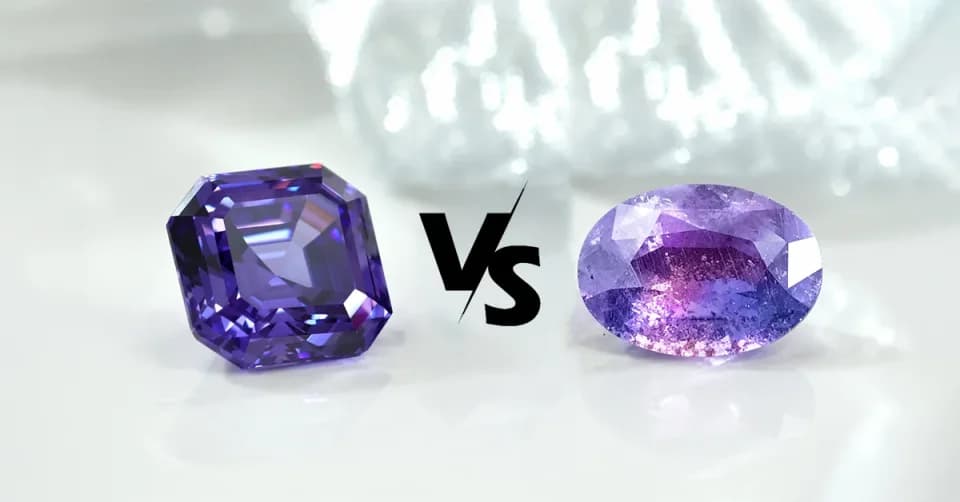
Visually for a layman both the stones have identical look to it. Even under magnification the differences are very subtle and require proper expert eyes to distinguish between both of them.
Interestingly lab-grown gemstones are often more flawless and natural stones have visible inclusions. This is also one of the reasons why buyers prefer the perfection of lab-grown stones, while some people value the uniqueness of the natural ones.
Durability and Performance
Due to the similarities of both the stones that is natural and lab-grown gemstones, this is the reason why both have the same hardness, offer same durability, and perform exceptionally well in everyday wear.
Environmental and Ethical Factor
This is one of the major reason why people prefer lab-grown gemstones as it is environmental and ethical factor to it. Lab-grown gemstones are against traditional mining, they reduce land disruption, and offer traceable sourcing, however, they still require energy-intensive processes.
On the other hand, natural gemstones involve mining processes which directly impacts the ecosystem and increasingly regulated the ethical sourcing. However, the lab-grown gemstones are marketed as eco-friendly, but the reality is more nuanced than that.
Resale and Investment Value
Resale and investment value is one criteria where the gap between natural vs lab-grown gemstones becomes significant.
- Natural gemstones have better value while resale.
- Lab-grown gemstones generally have lower resale value.
This is because natural stones are rare and lab-grown gemstones can be reproduced indefinitely.
Understanding Lab Created Diamonds: CVD vs HPHT
Now that we have talked about lab-created gemstones, let us also understand the lab created diamonds. This industry is primarily dominated by two things which is HPHT and CVD. HPHT stands for High Pressure High Temperature and CVD stands for Chemical Vapor Deposition.
Let us also have a deeper understanding of both these concepts:
HPHT (High Pressure High Temperature)
This is a technique in which it replicates the natural environmental in which the diamond forms.
- It uses extreme pressure and heat.
- Carbon crystallises around a seed.
- It produced diamonds similar to natural ones.
All this is often described as nature accelerated.
CVD (Chemical Vapor Deposition)
This is another more widely used technique, it consists of:
- Carbon-rich gas in vacuum chamber.
- It builds diamonds layer by layer.
- It offers greater control over quality.
CVD vs HPHT: Key Differences
|
Factor |
HPHT |
CVD |
|
Process |
It mimics natural formation |
This is a layer-by-layer growth |
|
Control |
Moderate |
High |
|
Production |
It produces faster bulk production |
It produces precision focused diamond. |
|
Popularity |
It is the traditional method |
This is the more modern preferred method. |
Both of these methods produce real diamonds which has identical physical properties. The choice of every person depends on certification, quality grading and budget and not just the method itself.
How Experts Tell the Difference?
Now that we have a seen and understood all the different methods and procedure, I’m sure there must be a common question being if both are so similar then how does an expert distinguishes between the same?
The answer to this question lies in the advanced gemmological testing and the technological advancements. The professionals use various methods for identifying the differences, those are as follows:
- Spectroscopy
- UV light analysis
- Inclusion pattern identification
These tools help in identifying the growth patterns, trace elements and the origin markers. Without the existence of these tools even the experienced jewellers may not be able to tell the difference between all of them.
Pros and Cons: A Practical Breakdown
Naturally everything has its pros and cons, so let us also discuss the same about both natural and lab-grown gemstones.
Natural gemstones
Pros
- Unique and rare
- Strong emotional value
- Better long-term investment potential
Cons
- Higher cost
- Ethical concerns in some cases
- Limited availability
Lab-grown Gemstones
Pros
- Affordable
- High clarity and visual appeal
- Ethical sourcing (in most cases)
Cons
- Lower resale value
- Less rarity
- Perception challenges among traditional buyers
Which One Should You Choose?
Choosing between a natural and lab-grown gemstones is not about right or wrong rather about priorities, therefore:
Choose Natural Gemstones If
- You have value for rarity and uniqueness.
- You are buying the stone for a long-term investment.
- You have an appreciation for the traditional craftsmanship.
Choose Lab-Grown Gemstones If
- If you want the maximum value for your budget.
- If you prefer flawless appearance.
- If you prioritise ethical considerations.
Conclusion
To conclude we can say that the conversation of natural vs lab-grown gemstones has evolved over time. This is not about authenticity or the reality of the stone as both of them are real, rather it is on the preference of the people.
Both the stones have their pros and cons, it up to people to decide what they wish for themselves and make a informed decision after that. Once you have understood the difference, the decision becomes less confusing and more about what really matters to you.

Durgesh Sharma
Durgesh Sharma is a passionate writer and certified gemstone expert with over four years of practical experience in the field of gemology. Alongside his creative writing journey, he specializes in helping individuals choose the right gemstones based on astrological principles and personal needs.
- Introduction
- What Are Natural Gemstones?
- Why Are Natural Gemstones Valued?
- What Is Lab-Grown Gemstones?
- Are Lab-Grown Gemstones Real?
- Natural vs Lab-Grown Gemstones: Key Differences
- Understanding Lab Created Diamonds: CVD vs HPHT
- How Experts Tell the Difference?
- Pros and Cons: A Practical Breakdown
- Which One Should You Choose?
- Conclusion