Kashmir Sapphire: Origin, Characteristics and Why It Commands a Premium Price?
Introduction
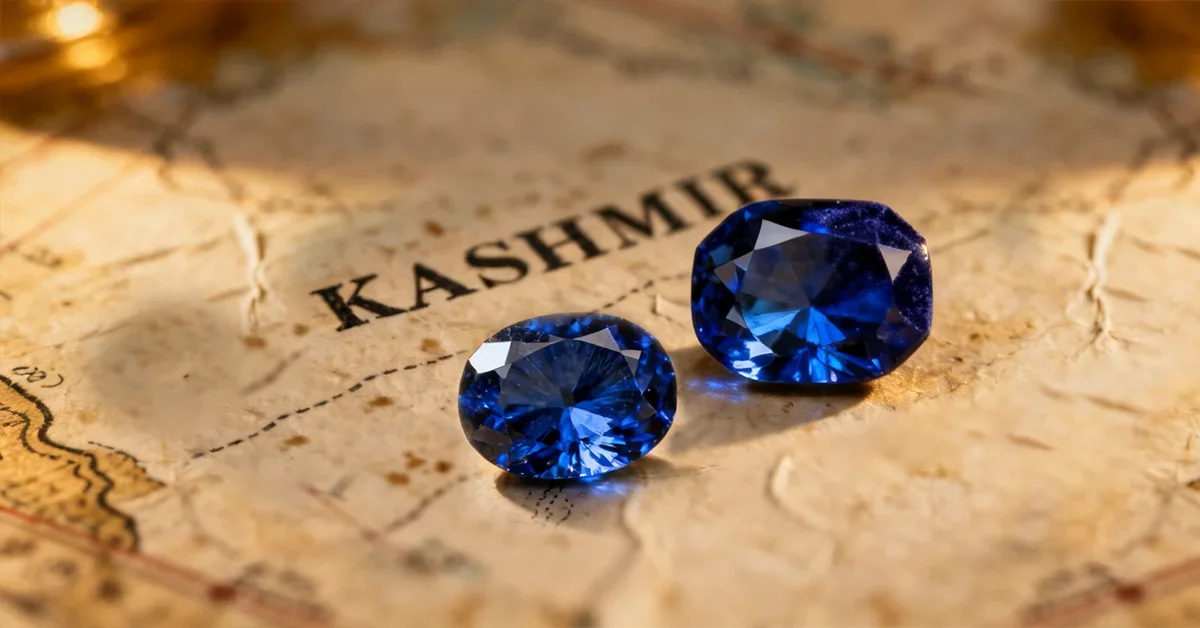
There are gemstones in the market which are beautiful and has their uniqueness to them but then there are gemstones that redefines the meaning of beauty. The second category is where the Kashmir Sapphires belong. For a long time, the Kashmir sapphire has held the status of being mythical in the world of fine gemstones. It was usually spoken about in the auction rooms, coveted by collectors, and was studied by gemmologists with a zeal that could been seen as obsession.
You must be thinking what is so special about theses sapphire, just their colour and rarity but that is not the whole picture. Kashmir sapphires are a combination of geological accident, historical timing along with optical perfection which was ever replicated again anywhere in the world. This is one of the biggest reasons for Kashmir sapphire price per carat discussions, and comparison of Ceylon vs Kashmir sapphire. The whole idea of sapphire origin premium continues to dominate the luxury gemstone market.
The aim of this blog is to go deep into the origin of these sapphires, what make these sapphires unique, and most importantly why they command such high prices for a coloured stone.
The Origin Story: A Mine That Changed Everything
The story of Kashmir sapphires starts from the late 19th century in one of the most remote areas and regions of the Himalayas. Around the years of 1881-1882, there was a landslide in the Zanskar range (Padder Valley) which revealed a deposit of blue sapphire which were unusual and very fine. Local traders came across these stones and soon after the region came under controlled mining which was backed by the Maharaj of Kashmir.
However, why these deposits are called unusual is because:
- The mine was hardly active for a small-time frame of 1882 to 1887 roughly.
- By the early 1900s, the sapphire deposits were nearly exhausted.
- Most importantly, no new production of such stones has been discovered to this date.
All these aspects combined means that every Kashmir blue sapphire circulating the market is at least a 100 years old.
This single fact of every stone being more than a 100 years old sets the stage for everything that follows it. Unlike diamonds or even other sapphires or rubies, Kashmir stones are not a part of an ongoing supply chain. These stone gain their respect from belonging to a closed chapter of geological history and not just their colour and quality.
The Signature Look: What Makes Kashmir Sapphires Unique
There is a distinct difference between a Kashmir sapphire and a sapphire from Sri Lanka or Madagascar. People with zero knowledge will also be able to tell the difference easily.
The Legendary ‘Velvet Blue Sapphire’
Why Kashmir sapphire has gained its reputation is mainly because of its velvety blue colour which is often referred to as cornflower blue or royal blue. But these labels don’t fully capture the entire essence of this beautiful stone, what actually sets it apart is:
- A soft yet diffused glow which is rather brilliant.
- Deep saturation without it being appearing dark.
- A slightly ‘sleepy’ or even luminous effect.
All these observations come from a microscopic rutile silk inclusion, which mans that it scatters light internally and creates a velvety texture.
Colour Stability
The reason behind Kashmir sapphire supremacy is because it maintains its colour under different lighting unlike other sapphires. One of the identification of Kashmir sapphires is that they maintain their consistency consistently through daylight, artificial light or even low light.
Balanced Inclusions
Usually, inclusions are considered flaws for majority of the stone, but this is not the case for Kashmir sapphires, in fact inclusions are a part of their appeal. If the stone is too clean then it loses its signature softness, however, if it is too included then clarity suffers. The finest stone have a rare balance.
Kashmir vs Other Origins: Why Origin Matters?
In the world of gemstones origin of the stone is not just restricted to its geography rather it is an indication of its value as well. Let’s have a clear distinction between blue sapphire from Ceylon and Kashmir.
Ceylon vs Kashmir Sapphire
Let’s have an easy and complete breakdown of the most common comparison: Ceylon vs Kashmir Sapphire.
|
Feature |
Kashmir Sapphire |
Ceylon (Sri Lanka) Sapphire |
|
Colour |
Velvety, deep, soft blue |
Bright, vivid, slightly lighter |
|
Texture |
Silky and diffused glow |
Transparent and more brilliance |
|
Availability |
It is extremely rare |
It is widely available |
|
Price |
The prices are exceptionally high. |
The prices are moderate to high. |
It can be seen that even though Ceylon sapphires are exceptionally beautiful they do not command the same price as a Kashmir sapphire. The reason behind the same is that origin of the stone carries a premium. For a matter-of-fact Kashmir sapphire alone can push prices from 5x to 10x higher for similar stones from other regions. This is what is known as sapphire origin premium in the industry.
Kashmir Sapphire Price Per Carat: Understanding the Numbers
Now let’s have look at the numbers and the things that actually drives the attention.
Current Market Range
The Kashmir sapphire price per carat varies dramatically depending on its carat weight and quality, some of the price points are as follows:
- Commercial-grade: $1,000 – $5,000 per carat
- Collector-grade: $15,000 – $40,000 per carat
- Investment-grade: $40,000 – $100,000+ per carat
- Museum-quality: $100,000 – $250,000+ per carat
There has been news of some stones found at auctions with perfect colour and no heat treatment exceeding the mentioned price per carat as well.
Why Prices Are So High?
The prices are not random, there are certain factors which drives the price of a stone, those are flows:
- The permanence of limited supply, there is a definite assurance that all the stones in the market are the only ones that exists and no other will be mined further.
- The stone comes from a legendary deposit, which is its historical significance.
- High-net-worth buyers and collectors actively look out for top-quality pieces with proper significance which contributes in determining the price point as well.
- Stones which have verification or certificate from top labs like GRS or Gübelin gives assurance about the stone which automatically then demands a higher price.
The Role of Heat Treatment: Why It Matters?
One of the biggest driver for any stone is that whether it is treated or not and same is the case with Kashmir sapphires.
- Unheated Kashmir sapphires are the rarest things existing in the market.
- An unheated Kashmir sapphire can be worth 3 to 5 times more than a heated one.
The reason behind this is that an untreated stone retains its natural colour formed under the geological conditions millions of years ago and not enhanced by a lab making it ever more reliable and valuable.
Auction Records and Market Trends
Kashmir sapphires are known for breaking records at the global auctions. Here are some of the highlights which depicts these claims:
- There have some of the Kashmir sapphire pieces which are known for exceeding $200,000 per carat. This is the statistics from when it has been recorded and here might be pieces in the market which we are unaware of.
- Even if a Kashmir sapphire is between the carat weight of 3-10 carats, it can command a price between six-figures.
One of the best examples of this, there a blue sapphire from Kashmir known as ‘Blue Belle of Asia’ which was sold for over $17 million. With these figures and information, we can say that Kashmir sapphire are not just gemstones, rather they are assets worth investing in.
Why Kashmir Sapphire Command a Premium Price
After all the information mentioned above the mystery attached to blue sapphire and its premium status should feel less intimidating and mysterious. Let’s focus further on this distilled logic:
- Kashmir sapphires come from a closed geological chapter as the mines are exhausted and the supply is fixed forever.
- Kashmir blue sapphire has gained their reputation because of their velvety blue sapphire effect which no other origin produces. This gives them an edge of an unmatched optical quality.
- There is a strong historical narrative as these stones come from a short-lived mine, royal connection and a fascination of over a century.
- There is a certain market psychology wherein the collectors prefer rarity, provenance and story as much as they care for the beauty of the stone.
- Like we mentioned about the prices of Kashmir sapphires at auctions, we can establish the fact that they have shown consistent appreciation making them a great asset for investing.
Risks and What Buyers Should Know
Now that we have discussed all the benefits of purchasing a blue sapphire, it is equally important to understand the risks involved because getting an authentic Kashmir sapphire is extremely difficult.
- Mislabelling of stones is quite common as there are various stone sin the market which are labelled as Kashmir sapphire but have no proof attached to them.
- Certification is important as it important to rely on reputed labs for an authentic report otherwise it is quite common to get scammed in the name of Kashmir sapphire.
- Liquidity of any piece like a Kashmir sapphire is difficult as they take time to be sold and also includes auction fees to them.
As a smart gem expert would put it, without a proper certification a blue sapphire from Kashmir is just an expensive blue stone with a great story.
The Emotional Factor: Beyond Numbers
There is an intangible factor to Kashmir sapphire which is the reason why collectors often times describe them as:
- Stones which have soft yet intense colour.
- They glow from within.
- They are calm yet very powerful stones.
For collectors and investors, the beautiful bit of a Kashmir sapphire is not just restricted to them being rare, it is also about owning something which nature created once for a brief period and then was found never again.
Conclusion
To conclude we can confirm that Kashmir sapphire sits at the very top of the hierarchy and there is a solid reason behind it. They are not famous only because of velvety blue colour, or the staggering Kashmir sapphire price per carat or even the historical mystique, they are a combination of three aspects combined.
They come from a short-lived mines from Himalayas that produced extraordinary beauty and then disappeared in a short time. This short time frame gave us a finite legacy which continues to define luxury gemstones till this date.
Today we have a market filled with alternatives, enhancements done to the stones, and many new discoveries, Kashmir sapphires remain untouched by time and all of them combined. This is the sole reason why they command a premium price which only a few stones can come close to.

Durgesh Sharma
Durgesh Sharma is a passionate writer and certified gemstone expert with over four years of practical experience in the field of gemology. Alongside his creative writing journey, he specializes in helping individuals choose the right gemstones based on astrological principles and personal needs.
- Introduction
- The Origin Story: A Mine That Changed Everything
- The Signature Look: What Makes Kashmir Sapphires Unique
- Kashmir vs Other Origins: Why Origin Matters?
- Kashmir Sapphire Price Per Carat: Understanding the Numbers
- Why Prices Are So High?
- The Role of Heat Treatment: Why It Matters?
- Auction Records and Market Trends
- Why Kashmir Sapphire Command a Premium Price
- Risks and What Buyers Should Know
- The Emotional Factor: Beyond Numbers
- Conclusion