The 4Cs explained: How Diamonds are Graded and Priced
Introduction
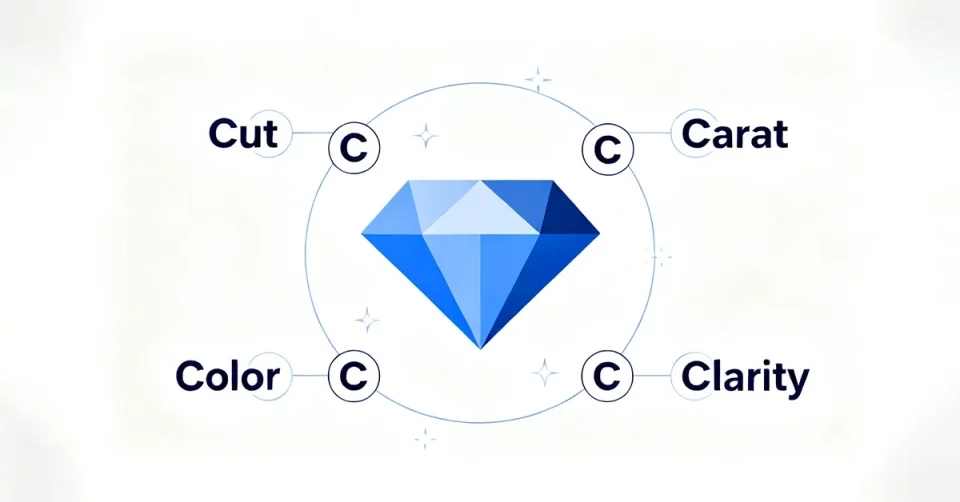
When we talk about the quality of a diamond or how to assess it, everything comes down to the four letters which is cut, colour, clarity and carat weight. Together these aspects are called the 4Cs of diamonds. These 4Cs are the universal language for evaluating, comparing and pricing every diamond in the world.
Originally these criteria were made by Gemological Institute of America in the 1940s, with these rules the diamond buying game transformed from a guessing game to a proper science-backed process. Therefoe, it is important to understand the GIA 4Cs which will eventually make a difference between overpaying and buying smart. Diamonds are most bought for engagement rings, and jewellery purpose, hence you should be aware of how to buy them.
The motive of this blog is to make sure that you understand the different criteria for buying diamond and how they are can be chosen from without you getting scammed about the same.
What Are the 4Cs of Diamonds?
The 4Cs of diamonds refers to the four key characteristics of identifying the diamond’s worth, those are cut, colour, clarity and carat weight.
We have explained each characteristic in great detail below but let’s first understand them briefly:
- Cut is how the diamond is shaped and how well it reflects light.
- Colour is how colourless the diamond is.
- Clarity is the presence of internal or external flaws present in the diamond.
- Carat is the weight along with the perceived size of the diamond.
Therefore, a diamond is not only valued looking at the size rather it is dependent on how well these four elements balance each other for an exquisite piece.
Cut: The Most Important Factor
If there is only one thing you remember while purchasing a diamond, then it should be the cut. A cut of the diamond has the biggest impact on its looks along with the price point. Often people mistake cut from the shape of the diamond which can be oval, round, princess, etc. However, cut of the diamond is how precisely the diamond has been faceted, the angles, symmetry, and proportions and how well it reflects light.
A well-cut diamond reflects light internally and sends it back to your eye as brilliance and sparkle. A poorly cut diamond will leak light which will eventually make it look dull even if it has colour and clarity to it.
How Cut is Graded?
The GIA has a scale through which they grade the diamond cuts, those are as:
- Excellent
- Very good
- Good
- Fair
- Poor
This grading of the diamond is based on factors like brightness, fire, and scintillation along with the craftsmanship of the person such as polish and symmetry.
The best way to navigate while looking at a diamond’s cut is to prioritize excellent or very good cut diamonds. Secondly, not to compromise too much on the cut to save money. Lastly, a small well-cut diamond will always have a better look and value then a large poorly cut diamond. Therefore, always keep these points in mind while purchasing a diamond.
Colour: Less Is More
Usually when we talk about stones, especially gemstones colour plays a vital role but in case of a diamond colour actually means the lack of colour. The most valuable diamonds are completely colourless which allows light to pass through without any distortion or breaks.
The GIA Colour Scale
GIA has graded diamond colour into categories, which are as follows:
- D–F: Colourless
- G–J: Near colourless
- K–M: Faint yellow tint
- N–Z: Noticeable colour
This grading by GIA is done on the basis of comparing diamonds against a master reference sone under controlled lighting conditions.
Ideally when one is purchasing a diamond, they should aim for value between G-H which looks colourless to the naked eye. In terms of premium jewellery, you can also opt for quality D-F. One biggest trick to use low grade or tinted diamonds is to pair them with yellow or rose gold to mask their colour.
Clarity: Nature’s Fingerprints
There is a saying which goes like ‘A diamond is a chuck of coal that did well under pressure’ by Henry Kissinger. This denotes that every diamond is formed under extreme pressure and heat under the Earth’s crust which means that it will contain tiny imperfections. These imperfections are called inclusions (the internal flaws), and blemishes (the surface flaws). Clarity is measurement of how visible these imperfections are.
The Clarity Scale Is:
- FL (Flawless) – extremely rare
- VVS1–VVS2 – very, very slight inclusions
- VS1–VS2 – very slight inclusions
- SI1–SI2 – slight inclusions (sometimes visible)
- I1–I3 – obvious inclusions
This clarity grading is done through 10x magnification, considering the size of the diamond, position, and lastly the number of inclusions.
Ideally you should look for VS1-SI1 for the best balance and avoid paying for a flawless piece unless it matters to you emotionally. You should also always check whether the inclusions are visible to the naked eye or not.
Read Also: Natural vs Lab-Grown Gemstones
Carat: Size vs Value
Carat is the weight of the diamond and not necessarily the visible size of the same. The simple calculation of a diamond is:
- 1 carat = 200 milligrams
- Divided into 100 points (e.g., 0.50 = 50 points)
Why Carat Impacts Price?
As we all know diamonds are natural, therefore, larger diamonds are rare and price doesn’t increase linearly rather they jump significantly at certain magic sizes, such as:
- 0.50 ct
- 1.00 ct
- 2.00 ct
What Should You Do?
- You can consider buying sizes which are slightly below the key weight, for example 0.90 ct instead of a 1.00 ct.
- Focus on the cut quality for maximising the perceived size.
- And always keep in mind the fact that two diamonds with the same carat weight can look entirely different and have very different price point as well.
How Are Diamonds Graded?
Diamond grading is not subjective to human evaluation and colour rather it is a proper scientific process. At the lab of GIA this scientific process is done through:
- Multiple experts who work independently evaluate each and every diamond.
- They evaluate the diamonds in standardised lights and tools are used for the same.
- Results are cross-checked several times before final grading is done.
- Precision tools are used to measure the carat weight to the extreme accuracy and for achieving on point results.
Therefore, a certificate from a lab like GIA acts like a diamond’s identity card which provides details of all four Cs along with confirming the piece’s authenticity.
How Diamonds Are Priced?
There are several factors which affects the pricing of a diamond. Therefore, below are some combinations which will help you in getting a better idea of how the pricing is done for a diamond.
The 4Cs Work Together
No single factor plays a role in determining the price, instead it is a combination of a few things which are:
- High cut and low carat are equivalent to affordable brilliance.
- High carat and low clarity give you bigger but flawed.
- The perfect balance of cult, clarity, colour and carat weight provides the best value diamond.
Rarity Drives Price
- Flawless diamonds with exceptional clarity are rare which makes them expensive.
- Colourless diamonds are also rare keeping them in the premium range.
- Larger diamonds again are rare which makes them exponentially priced.
Cut Can Increase or Decrease Value
As mentioned prior as well, the cut of a diamond is one of the biggest deciding factor for the price point. Even when the diamond has identical carat, colour and clarity the:
- Better cut diamond will demand higher price.
- And a poor cut diamond will be discounted.
Certification Matters
Lastly, certification is the biggest tool for knowing the authenticity of a diamond, a certificated diamond from a trusted lab like GIA might cost more. However, they will offer transparency along with a resale confidence.
A Practical Diamond Buying Guide
After all the explanation, to sum it up in an even simpler manner of how to buy a diamond, there here are the tips:
- Step 1 is to set a budget before you start looking for a diamond.
- Step 2 is to always prioritise the cut of the diamond. Look for the best cut in your budget.
- Step 3 is to find a balance between colour and clarity. The best way to approach it is to go slightly lower where differences aren’t that visible and avoid paying for perfection hat you can’t see.
- Step 4 is to look for a size which is best suitable for you rather than rounding off the carat number.
- Step 5 and the most forgettable step is to always ask for certification, this will provide authenticity and resale value.
Common Mistakes Buyer Make
Some of the common mistakes people make while purchasing a diamond are:
- Focusing only on the carat size, which is the size of the diamond.
- Ignoring the cut quality, which is the most integral part.
- Overpaying for a flawless clarity diamond.
- Not checking the certification during the time of purchase.
- Buying a price based on its appearance rather than the grading of cut, colour, clarity.
The Future of Diamond Grading
The future of a diamond is evolving with the changing market. However, the GIA 4Cs still remains the gold standard for natural diamonds. There has been a shift in how lab-grown diamonds are graded with a much more simpler and simplified systems in the recent years.
Conclusion
By understanding the 4Cs of diamond is not about being a gemmologist, rather it is more about gaining clarity on the subject and making an informed decision for yourself. When you simplify it, the cut of a diamond provides sparkle, colour gives purity, clarity gives cleanliness, and carat gives the size of the diamond.
The trick is to balance all 4 together. You will become a smart buyer when rather than chasing perfection you will find the right combination for yourself according to your budget and taste. Once, you get a clarity on this subject then the diamond market becomes easy for you.

Durgesh Sharma
Durgesh Sharma is a passionate writer and certified gemstone expert with over four years of practical experience in the field of gemology. Alongside his creative writing journey, he specializes in helping individuals choose the right gemstones based on astrological principles and personal needs.