Natural vs Synthetic vs Imitation Gemstones: What's the Difference?
A gemstone sparkle may catch your eye, but its origin, composition and optical properties determine its true value.
These stones have been treasured for centuries, for their beauty as well as for their deep-rooted significance to the cultures of the world, and their enduring value.
Gemstones including laboratory-grown stones are becoming increasingly popular, and it can be difficult for the buyer to tell the difference between stones that are made in a laboratory and fake stones that are designed to look like real gemstones.
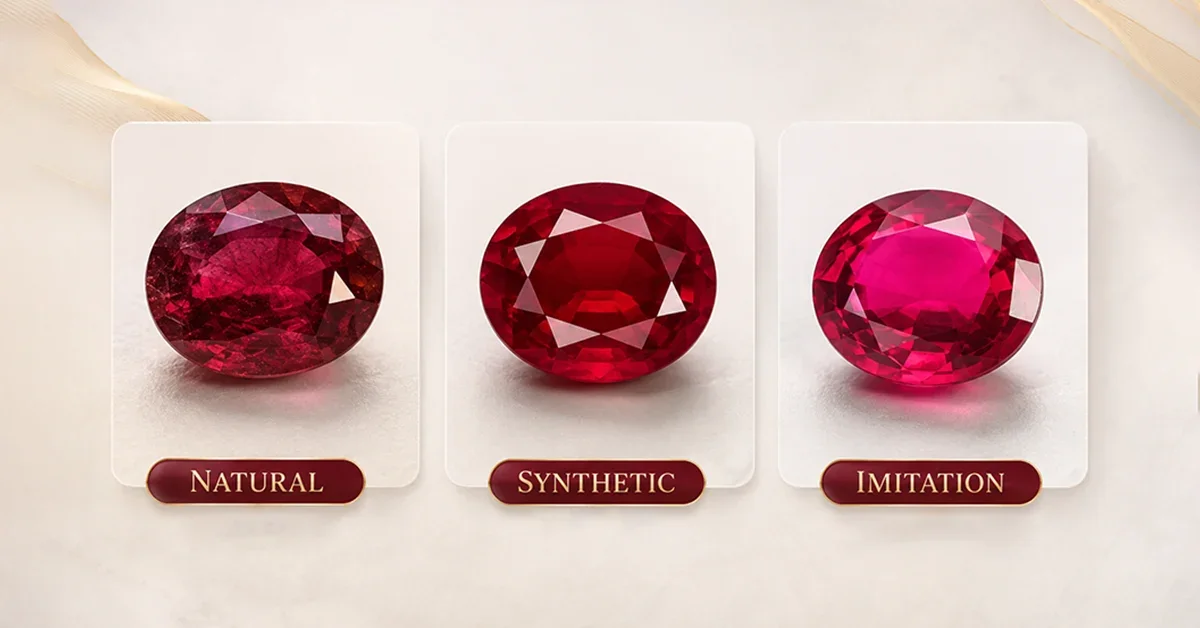
This guide explains the differences between natural, synthetic, and imitation gemstones with regards to origin, value, appearance, and durability.
What Are Natural Gemstones?
Natural gemstones form inside the Earth by natural geological processes.
The stones are minerals, rocks, or even organic material and were formed naturally, without any human intervention.
Examples of natural gemstones include diamonds, rubies, sapphires, emeralds, pearls, amber, and opal.
What Are Synthetic Gemstones?
Synthetic gemstones are created by man in the laboratory instead of forming naturally underground. These stones are identical in chemical composition, physical, and optical characteristics to their natural counterparts.
Synthetic gemstones are man-made in a laboratory and are generally more affordable than natural gemstones. The growth characteristics will differ from natural stones as they have been produced in a controlled environment.
What Are Imitation Gemstones?
Imitation Gemstones are made of glass, plastics, ceramics, and other materials to resemble stones.
Unlike lab-grown gemstones, they do not have the same chemical composition or crystal structure as the stone they imitate.
Key Differences Between Natural, Synthetic, and Imitation Gemstones
Natural, synthetic, and imitation gemstones might look the same, but they differ in origin, composition, properties, value, and ethical considerations.
Below are the key differences between natural, synthetic, and imitation gemstones.
|
Key Difference |
Natural |
Synthetic |
Imitation |
|
Composition |
Naturally occurring minerals/organic material |
Same composition as natural counterpart |
Different material |
|
Formation |
Formed naturally over millions of years |
Lab-created under controlled conditions |
Manufactured to mimic another gem |
|
Optical Properties |
Refractive index and dispersion depend on the gemstone's composition and structure. Cut, clarity, and polish affect brilliance. |
Similar optical properties to natural counterpart |
Different optical properties |
|
Physical Properties |
Hardness depends on the gemstone species. Natural inclusions are commonly present. |
Generally similar to natural counterpart |
Depends on material used, like plastic, glass or ceramic |
|
Value |
Usually highest due to rarity |
Generally more affordable |
Usually lowest |
|
Environmental Impact |
Mining can disturb land and ecosystems |
No conventional mining; still uses energy/resources |
Depends on materials and manufacturing |
1. Composition
Natural gemstones
Natural gemstones are made up of minerals or organic materials and they are formed by natural processes under the earth. Their chemical composition depends on the gemstone variety, such as corundum in ruby and sapphire or beryl in emerald.
Synthetic gemstones
Synthetic gemstones have the same chemical composition and crystal structure as their natural counterparts.
A laboratory-grown ruby, for example, is chemically and physically similar to a natural ruby.
Imitation gemstones
Imitation gemstones have a different chemical composition from the gemstone they resemble.
They may be made from glass, plastic, ceramic, resin, or another natural or laboratory-created material. Cubic zirconia, for example, is commonly used as an imitation for diamond
2. Formation Process
Natural gemstones
Natural gemstones are formed under the earth over millions of years through geological processes. They are then extracted through mining and collected through natural deposits.
Synthetic gemstones
Synthetic gemstones are made by humans in the laboratory under controlled conditions.
They are produced using methods such as flame-fusion, hydrothermal, flux-growth, or crystal-pulling.
It may take weeks months or longer to produce lab-grown gemstones depending on the material and method.
Imitation gemstones
Imitation gemstones are manufactured to copy the appearance of another gemstone.
They are produced from materials such as glass, plastic, resin, ceramic, or different gemstones and are different from laboratory-grown versions of the stone they imitate.
3. Optical Properties: Refractive Index, Dispersion, and Brilliance
Optical properties refers to how a gemstone interacts with light. The most important factors include refractive index, dispersion, transparency, color, cut, polish, and crystal structure.
Natural gemstones
A natural gemstone refractive index is dependent on its chemical composition and crystal structure.
A higher refractive index lead to stronger light reflection, on the other hand brilliance is dependent heavily on the gemstone’s cut, proportions, transparency, and polish.
A poorly cut gemstone may look dull even when it has a high refractive index.
Natural gemstones may also display dispersion, commonly called “fire.” Dispersion occurs when white light separates into spectral colors as it passes through the gemstone. The amount of fire depends on the stone’s material, cut, size, and viewing conditions.
Synthetic gemstones
A synthetic gemstone are made up from the same material as a natural gemstone and the has almost the same refractive index, dispersion, and potential brilliance.
For example, synthetic sapphire has optical properties as similar to natural sapphire. However, its final appearance may differ because of difference in clarity, growth features, color distribution, cutting, and polishing.
Synthetic gemstones are not automatically more brilliant than natural gemstones, the quality of the cut and quality are more important than origin alone.
Imitation gemstones
An imitation gemstone is manufactured to resemble another gemstone but has a different composition and optical properties.
Its refractive index, dispersion, transparency, and light return may be higher or lower than those of the stone it imitates.
For example Cubic zirconia generally shows slightly more fire but less white-light brilliance than diamond.
4. Physical Properties: Hardness, Durability, and Inclusions
Physical properties determine how well a gemstone resists everyday wear and damage. Hardness, toughness, stability, cleavage, fractures, and inclusions all affect a gemstone’s durability.
Natural gemstones
The hardness of a natural gemstone depends on its mineral species and crystal structure. However, a high hardness rating does not guarantee complete durability because a gemstone may still have cleavage planes, internal fractures, or weak edges.
Natural gemstones commonly contain inclusions formed during their growth. These may include crystals, needles, fluids, clouds, healed fractures, or gas-filled cavities.
Synthetic gemstones
A synthetic gemstone made from the same material as a natural gemstone generally has comparable hardness, density, toughness, and stability.
How long it holds up in a ring has less to do with lab vs. mined and more to do with how it was cut - a badly cut stone chip regardless of its birth certificate.
Synthetic gemstones can also contain inclusions. Laboratory-grown stones also show curved growth lines, gas bubbles, flux remnants, metallic inclusions, or distinctive growth structures which are related to its production method.
Imitation gemstones
The physical properties of an imitation gemstone are associated with whether it is made up of glass or plastic, ceramic or resin.
Imitation gemstones are often less resistant to scratching, moreover materials such as cubic zirconia and moissanite are relatively hard and durable.
Imitations may also show recognizable internal features. Glass can contain rounded gas bubbles or swirl-like structures, while plastic may show very few natural-looking inclusions.
5. Monetary Value
Natural gemstones
Natural gemstones are more expensive because of their rarity, origin, quality, size, color, clarity, treatment status, and demand.
Exceptionally untreated or rare natural stones are good for investement purposes.
Synthetic gemstones
Synthetic gemstones are generally less expensive than natural gemstones because they can be produced in controlled quantities.
Buyers are really paying for the setting, colour, cut, certification and the workmanship here, not the stone itself.
Imitation gemstones
Imitation gemstones are usually the most affordable option because they do not possess the same composition or rarity as the stone they imitate.
Their value is mainly based on appearance, craftsmanship, material quality, and jewelry design.
6. Ethical and Environmental Impact
Natural gemstones
Natural gemstone are mined from natural deposit which lead to land disturbance, energy use, water consumption, habitat loss and social and labour concerns.
It can provide employment and economic benefits, so responsible sourcing, traceability, labor standards, and reputable certification can help address these risks.
Synthetic gemstones
Laboratory-grown gemstones avoid conventional mining and may reduce land disturbance, but they can still affect the environment depending on the energy source, manufacturing process, water use, and factory practices.
Lab-grown does not automatically mean impact-free or completely sustainable.
Imitation gemstones
Imitation gemstones can reduce demand for mined material affecting the sustainability of earth, but plastics and resins may create waste and long-term disposal concerns.
Their ethical and environmental profile depends on the raw materials, manufacturing conditions, durability, and recycling options.
Should I BuyNatural or Synthetic Gemstones?
The right gemstone ultimately depends on your budget, purpose, and personal preferences.
- For budget-conscious buyers: Synthetic gemstones offer the look of natural gems at a lower price and with a smaller environmental footprint.
- For collectors: Natural gemstones are valued for their rarity, unique formation, and individuality.
- For jewellery lovers: Choose the gemstone that best matches your style, budget, and quality expectations.
- For astrological purposes: Many Vedic astrologers recommend natural gemstones for their believed planetary energies.
- For long-term value: High-quality natural gemstones are generally preferred for their rarity and investment potential.
FAQs
1. Are Synthetic Gemstones Real?
Yes, synthetic gemstones are real gemstones because they have the same chemical composition, crystal structure, and physical properties as their natural counterparts.
2. Are Synthetic Gemstones Valuable?
Yes, synthetic gemstones have value as attractive, durable, and more affordable alternatives to natural gemstones.
Their price depends on the gemstone type, quality, size, cut, color, certification, and market demand, so they are usually better suited to jewelry use than investment purposes.
3. How Can You Identify Whether a Gemstone Is Natural, Synthetic, or Imitation?
Natural, synthetic, and imitation gemstones can look remarkably similar, making visual identification difficult.
The most reliable way to determine it is through certification from a reputable gemological laboratory, such as GIA or SSEF, along with professional testing that examines its inclusions, chemical composition, and growth characteristics.
To Sum Up
It is important to understand the differences between natural vs synthetic vs imitation gemstones for making a confident and informed purchase.
The right choice between natural, synthetic, and imitation gemstones ultimately depends on the budget, purpose, and personal preferences of the buyer.
Regardless of the option you choose, always buy from a trusted seller and request a reputable gemological certificate to ensure authenticity and transparency.
Stay updated with Gemstone Today for more gemstone-related information.

Pankhur Grover
Pankhur is a Content enthusiast who loves to bring stories to life through words. She enjoys turning complex ideas into engaging, informative content. Her curiosity often leads her to discover inspiration from the most unexpected places. From the world of fashion and lifestyle to gemstones and jewellery, she loves discovering fresh perspectives and bringing interesting details to readers.