Understanding Grading Scales Used in Gemstone Reports
Introduction
For a layman whenever you pick up a gemstone report you might feel that you are reading some foreign language. The report consists of letters, numbers, abbreviations along with technical descriptions which boils down to one thing being the value of the gemstone. Behind the complexity of a gemstone report is the structured gemstone grading system which is designed in such a manner as to standardise the evaluation of gemstone across world platform. This standardised evaluation helps in determining a standard price point for the gemstone as this industry is varied according to place and the seller.
This blog here is brought for your better understanding which will break down the system and actually make sense of it. You could be a buyer, trader, a curious person or even an investor; understanding how grading scale works in gem reports will always change your vision of looking at the gemstones forever.
What Is a Gemstone Grading System?
To understand from the basics a gemstone grading system is a standard method used by the gemmological laboratories for evaluating the quality of the stone. This gemstone grading system is often seen in the form of a report which assesses measurable and visual characteristics of a gemstone which includes characteristics like colour, clarity, cut, and carat weight.
The motive of this grading system is to create consistency amongst different region in terms of the same gemstone. This means when a sapphire or any stone is graded in India should have the same value as it would have been graded in the US or Europe. There are institutions like Gemological Institute of America commonly referred as the GIA is the pioneer of this system. GIA has been given the highest value because before their grading there were terms like ‘loupe clean’ or ‘fine colour’ which are often considered as quite subjective terms.
With the start of this gemstone grading system, there is an ensured comparison between gemstones which are objective. This grading is regardless of whether they are sold or not.
Why Grading Scales Matter in Gem Reports?
Before we get into the technicalities of the gemstone grading system, let’s understand why it is important and why do it even exist in the first place.
A gemstone’s price is not selected randomly. It is rather tied directly with the gem quality scale. This scale is a reflection of rarity and visual appeal of the said gemstone. Even the slightest difference in the scale can lead to a significant price gap. The intention of having a grading scale is as follows:
- It helps in eliminating guess work for buyers.
- It creates a trust factor while making transactions.
- It is a standardised norm for global trade.
- It supports fair pricing for across the regions and market hubs.
Without the help of these systems, it would be difficult to compare two gemstones as people would have to rely on subjective judgement.
The Foundation: The 4Cs of Gemstone Grading
Most of the modern gemstone reports are based on certain parameters which are as follows:
- Colour
- Cut
- Clarity
- Carat weight
These are the four basic parameters or the backbone which forms nearly every gemstone grading criteria framework which is used worldwide. While all the four parameters matter, colour and clarity grading scale of gemstones carries the maximum amount of weight. This is especially the case for diamonds and high value-coloured stones.
Colour Grading Scale in Gemstones
Now that we know that colour grading sale holds great amount of weightage in the deciding the price of a gemstone. Let’s understand what exactly colour grading scale is because it is not just about the colour of the stone rather there are three main aspects to it, which are as follows:
- Hue is the actual colour like blue, red, green, etc.
- Tone is the lightness or the darkness of the stone.
- Saturation is the intensity or purity of the gemstone.
In case of diamonds, the scale is highly standardised by the Gemological Institute of America (GIA). They use the D to Z scale which means:
- D–F: Colourless (highest quality)
- G–J: Near colourless
- K–M: Faint colour
- N–Z: Noticeable colour
For a diamond, the lesser the colour it has, the higher would be their value in majority of the cases.
In terms of coloured gemstones, the matter is more nuanced. Coloured gemstones like ruby, emerald, sapphire, etc. are known for their rich and saturated colour unlike diamonds which are valued for no colour. This is one of the biggest reason why there is no alphabetical scale for all the gems across globe like that of diamonds.
Read Also: What Is Heat Treatment in Gemstones?
Clarity Grading Scale Explained
The second most valuable gemstone grading scale is the clarity of the gemstone. Clarity in general means how clean the gemstone is internally as well as externally. Clarity is the measure of two components, them being:
- Inclusions which are the internal features.
- Blemishes on the other hand are the surface imperfections of the stone.
There is a widely accepted clarity scale for diamonds which includes 11 grades, they are as follows:
- FL (Flawless)
- IF (Internally Flawless)
- VVS1–VVS2
- VS1–VS2
- SI1–SI2
- I1–I3
These are the grades done after thorough examination done by the experts under a 10x magnification. Fewer visible imperfections mean a higher clarity grade which also directly means higher value of the stone.
Interesting Facts
The interesting bit is clarity is not universal for all the gemstones. This is because coloured stones work slightly differently on the logic:
- Emeralds are more precious when they have slight inclusions in them.
- Aquamarines on the other hand is known for they clean look.
- Some of the inclusions in the stone are know for enhancing their value.
Due to these reasons the gemmologists have classified stones in Type 1, Type 2, and Type 3 categories. These categories are based on their expected clarity characteristics. This is one of the most important things which is often missed out while interpreting and reading reports.
Read Also: Fracture Filling vs Natural Stones: Which Is Better?
How Grading Scales Work in Gem Reports?
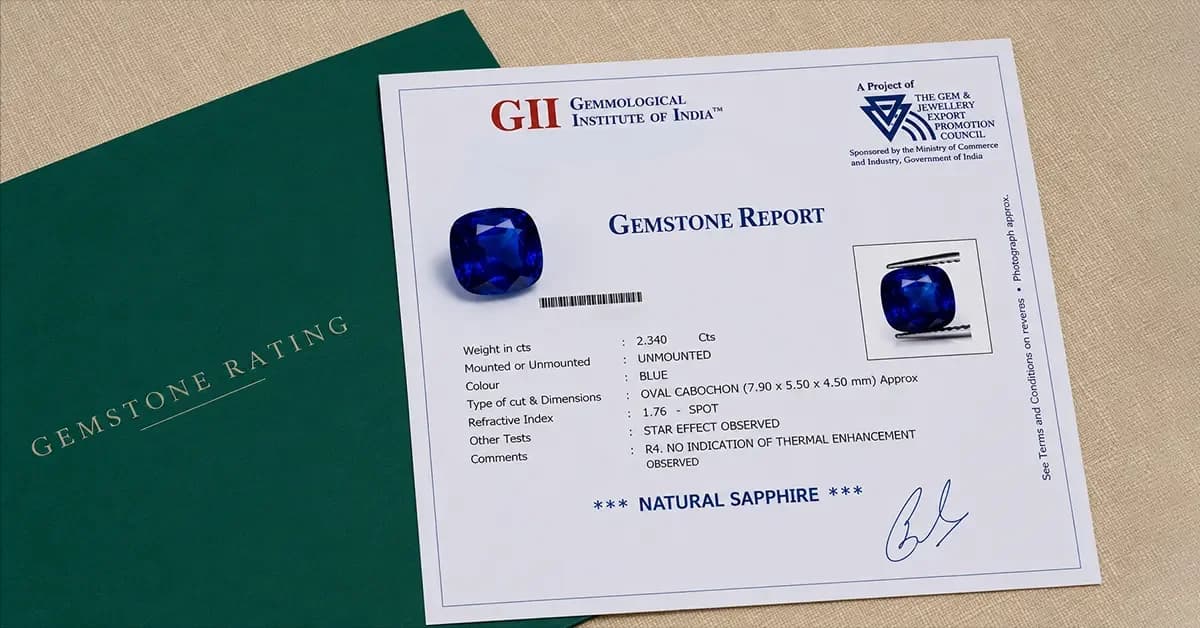
Now that we have an understanding of why a grading scale is important, let’s understand how a grading scale in gem reports work. This means that there are various factors which comes together to form one final evaluation. A typical report involves:
- It will have an identification section which will confirms whether the gemstone is natural, synthetic or treated.
- The measurement in dimensions and caret weight of the stone.
- The report might include the tone and saturation details of the stone which is especial case for the coloured gemstones.
- Clarity grade of the stone based on the inclusion visibility and distribution.
- Cut and shape is also evaluated like the proportions, symmetry and polish of the stone.
- Some of the additional observations are also done to the stone like any treatments done to the stone, its origin, fluorescence, etc.
Each of these sections uses a separate grading scale but together they are defined as the gem quality scale.
The Role of Subjectivity in Grading
Here is the biggest thing which most of the guides will not speak about is that grading is not entirely objective. This means that even with standardised system, gem grading has a great involvement of human interaction. For example,
- Two stones which are on the borderline of VS2 and SI1 might receive very different grades.
- Lighting conditions in which the grading is being done can greatly affect the colour perception.
- Inclusion placements might impact the grading even more than the size of the stone.
Experts evaluate various factors like size, position, number and even visibility of inclusions while assigning clarity grades. This is the reason why reputable laboratories and consistency matter more than the grade alone.
Differences Between Diamond and Coloured Gemstone Grading
One of the biggest misconception people often have that all the gemstones follow the same grading system as a diamond, but this is not the case. Grading system is different for diamonds and coloured gemstones. Below is the classification:
Diamonds
- They have highly standardised grading
- They have strict scales for colour and clarity.
- They heavily rely on the 4C classification.
Coloured Gemstones
- There is no universal grading system for a coloured gemstone.
- For coloured gemstone there is a greater emphasis on the colour quality.
- Clarity expectations for a coloured gemstone vary by its type.
For a matter of fact, there is no single clarity grading system which applies equally to all the coloured gemstones as every stone has their unique characteristics. These are few of the points which makes understanding gemstone grading criteria even more important for buyers while dealing in coloured gemstones.
Common Mistakes While Reading Gem Reports
Some of the common mistakes people do while reading a gem report, which can also be done by an expert are as follows:
- Assuming that higher grade stone will always be of better value. This is not the case as sometimes lower grace stones offer better clarity and visual appeal at a better price.
- They ignore the gem type difference and compare clarity of an emerald with diamond which is misleading.
- They overlook the cut quality of the stone. As a well-cut stone can appear more brilliant than a higher-grade stone with a poor cut.
- Misunderstanding the eye clean as there are various stone with inclusions which will appear flawless to the naked eye.
The Future of Gemstone Grading
The future of gemstone grading is evolving. There are recent developments which shows that even in the established systems things are being reconsidered. For instance, the Gemological Institute of America has started shifting their focus towards a simplified grading for lab-grown diamonds. This replaces the traditional scales with broader descriptors like ‘Premium’ and ‘Standard’.
This shift in the interpretation will reflect a larger trend which will make the gemstone report easier for the consumer to understand without them losing their accuracy.
Conclusion
We can conclude to the fact that a gemstone report is more than a certificate. It is a story of how the gemstone is formed, evolved, and evaluated. Therefore, it is important to understand the gemstone grading system which will provide you an edge. It will help you to move beyond the marketing language and focus on things which actually matters like the visual beauty, rarity and suitability of the gemstone according to the purpose.
A smart buyer will not only look for grades, but they will also understand the meaning and the context of the grade as well. This is because in the world of gemstones, numbers and letters are not just a definition of the quality of the stone. It is also shapes the perception, value, and ultimately the decision to buy as well.

Durgesh Sharma
Durgesh Sharma is a passionate writer and certified gemstone expert with over four years of practical experience in the field of gemology. Alongside his creative writing journey, he specializes in helping individuals choose the right gemstones based on astrological principles and personal needs.
- Introduction
- What Is a Gemstone Grading System?
- Why Grading Scales Matter in Gem Reports?
- The Foundation: The 4Cs of Gemstone Grading
- Colour Grading Scale in Gemstones
- Clarity Grading Scale Explained
- How Grading Scales Work in Gem Reports?
- The Role of Subjectivity in Grading
- Differences Between Diamond and Coloured Gemstone Grading
- Common Mistakes While Reading Gem Reports
- The Future of Gemstone Grading
- Conclusion