Indian Gem & Jewellery Exports Under Pressure as US Shifts to Section 301 Tariff Regime
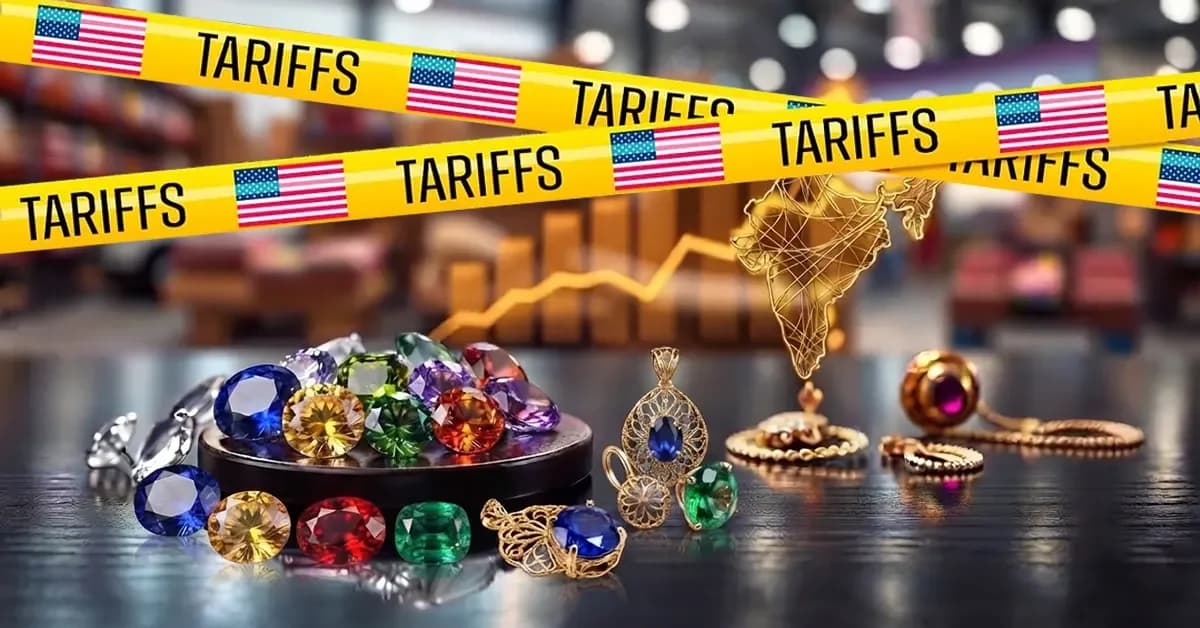
The rules of the game for India's gem and jewellery trade with America have just changed and not entirely in India's favour.
USA moved on from its temporary Section 122 balance-of-payments surcharge to a new permanent Section 301 tariff regime. Indian exporters must pay a 10% tariff on gem and jewelry shipments to the US.
The switch from Section 122 to Section 301 isn't just a name change. It marks the end of a broader review by the Office of the United States Trade Representative (USTR), which spent months examining how 60 different economies enforce bans on goods made with forced labor.
GJEPC Rejects Forced Labour Claims Against India's Gem & Jewellery Industry
Because the entire Section 301 review focused on forced-labour enforcement, India's placement in the new tariff structure is tied directly to its labour practices. The Gem & Jewellery Export Promotion Council (GJEPC) wasted no time pushing back on any suggestion that the industry has a forced-labour problem.
Council Chairman Kirit Bhansali said, "At the outset, we categorically reject any implication that India's gem and jewellery sector is linked to forced labour."
GJEPC also used the moment to welcome the amendment to the Foreign Trade Policy, which now formally bars the import of any goods produced wholly or partly through forced labor.
It is an important step towards international labor standards, including a forced-labor clause.
Even so, Bhansali didn't hold back on how he feels about the outcome. He called the continued 10% tariff "not at all justified," especially given that some of India's biggest rivals in the diamond trade still enjoy duty-free entry into the US market.
How India Benefits From the New U.S. Tariff Regime
India secured a spot in the lower 10% tariff band under Section 301. Several of India's biggest competitors in manufacturing and trading, such as China, Hong Kong, Thailand, Türkiye, the UAE, Israel, and Vietnam, were placed in the higher bracket and now face an additional 12.5% tariff.
This gives Indian exporters a competitive tariff advantage of 2.5% in the U.S. market, making Indian-made jewelry slightly cheaper than from rival hubs.
Key Challenges For The Gem And Jewellery Industry
The above-mentioned advantage doesn't erase the underlying cost pressure. This is really where the story gets uncomfortable for Indian exporters, and it's worth breaking down piece by piece.
Indian Jewellery Faces an Effective 15.5%–16% U.S. Import Duty.
The 10% Section 301 tariff doesn't apply in isolation; it stacks on top of the existing US Most Favoured Nation (MFN) duty, which already sits at 5.5%–6% for jewellery.
Add the two together and Indian jewellery exporters are effectively looking at an all-in import duty of roughly 15.5% to 16% once it lands on US soil.
Must Read: Top Gemstone Jewellery Trends from India Couture Week 2026
Indian Natural Diamonds Face a Competitive Disadvantage
Perhaps the sharpest pain point in the entire new regime is the treatment of natural diamonds. Belgium, being one of the world's great diamond trading hubs, continues to enjoy a 0% additional tariff on natural diamonds entering the US. Indian-origin natural diamonds, by contrast, still face the full 10% duty.
Lab-Grown Diamonds and Synthetic Stones Also Face the Tariff
It isn't only natural stones. Lab-grown diamonds and synthetic stones also remain fully subject to the additional 10% duty. They are no exception, which means the tariff pressure extends across essentially the entire diamond category, not just the traditional mined-stone trade.
Rough Diamonds Processed in India Remain Subject to the Tariff
Several major diamond-producing countries, including Botswana, Namibia, the Democratic Republic of the Congo, Zimbabwe, Sierra Leone, Liberia, Ghana, Tanzania and Mauritius, remain outside the scope of the current Section 301 action.
US customs rules treat rough stones that originate outside India and are substantially transformed (cut and polished) in India as Indian-origin. That means the 10% tariff still applies on export to the US, regardless of where the rough material was originally mined.
What Comes Next for Indian Exporters
GJEPC has emphasized that natural diamonds and coloured gemstones are essential raw materials for the jewelry manufacturing sector and has called for their exemption from the additional tariff proposed under Annex III.
The Council is also working closely with the Government of India to accelerate the India–U.S. Bilateral Trade Agreement (BTA), aiming to narrow the existing tariff disparity and strengthen the competitiveness of India’s gem and jewelry exports in the U.S. market.

Meha Khera
For Meha Khera, luxury is far more than an expression of style—it is a reflection of craftsmanship, heritage, culture, and timeless elegance. With over a decade of experience in editorial, content strategy, and brand storytelling, she has dedicated her career to uncovering and narrating stories that shape the world of luxury.